
THE BARN DOOR GALLERY
AT 33 HAWLEY
Stewarded by the Northampton Center for the Arts (NCFA), the Barn Door Gallery supports our mission to foster community connections through the arts, and is a dedicated venue for evolving, transformative dialogue between artists and audiences.
OPEN HOURS:
12 pm - 7 pm - Wednesday, Thursday, Friday & Saturday
Closed - Sunday, Monday & Tuesday
The Barn Door Gallery is ADA compliant and admission is free.
Additional information can be found on our FAQ document.
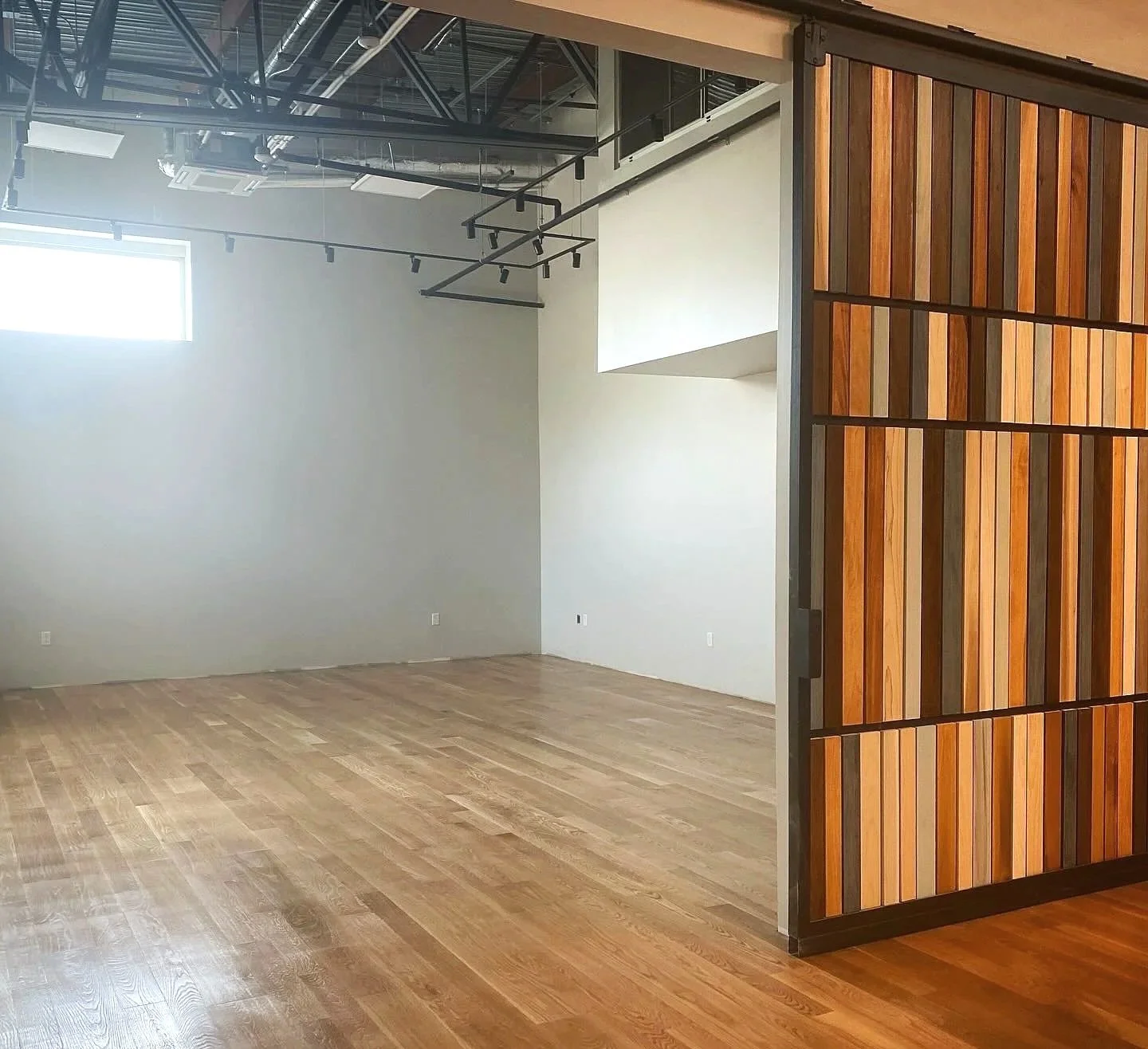
THE SPLIT LEVEL GALLERY AT 33 HAWLEY
Stewarded by the Northampton Center for the Arts (NCFA) and A.P.E . (Available Potential Enterprises, Ltd.) the curation of this gallery is shared by both building partner organizations and supports our mission to foster collaboration and community connections through the arts.


Current Exhibits:
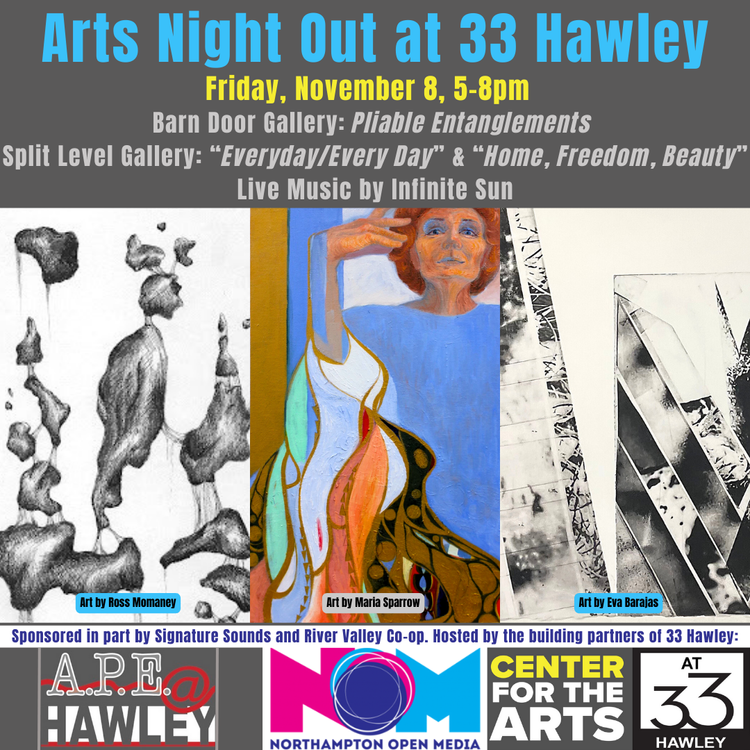
November 2024
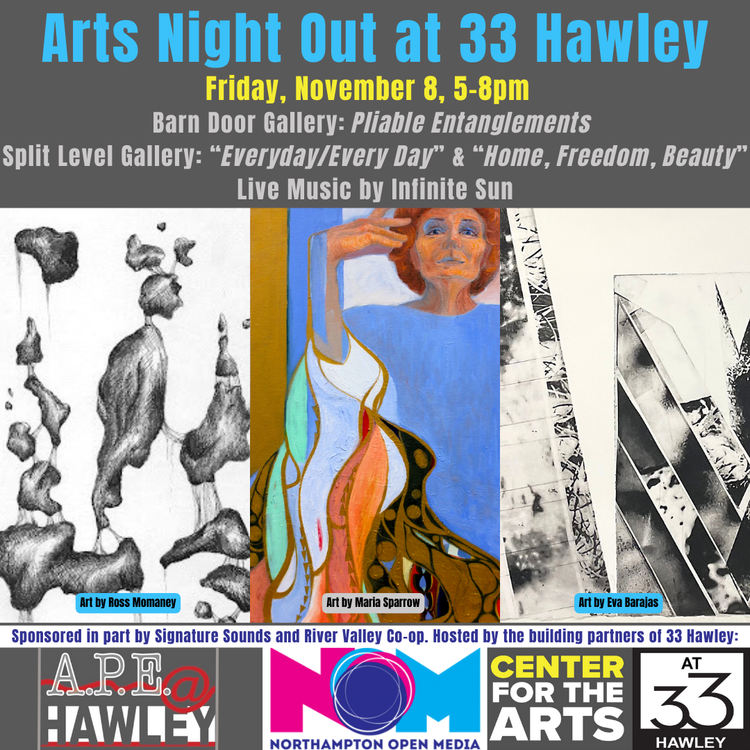

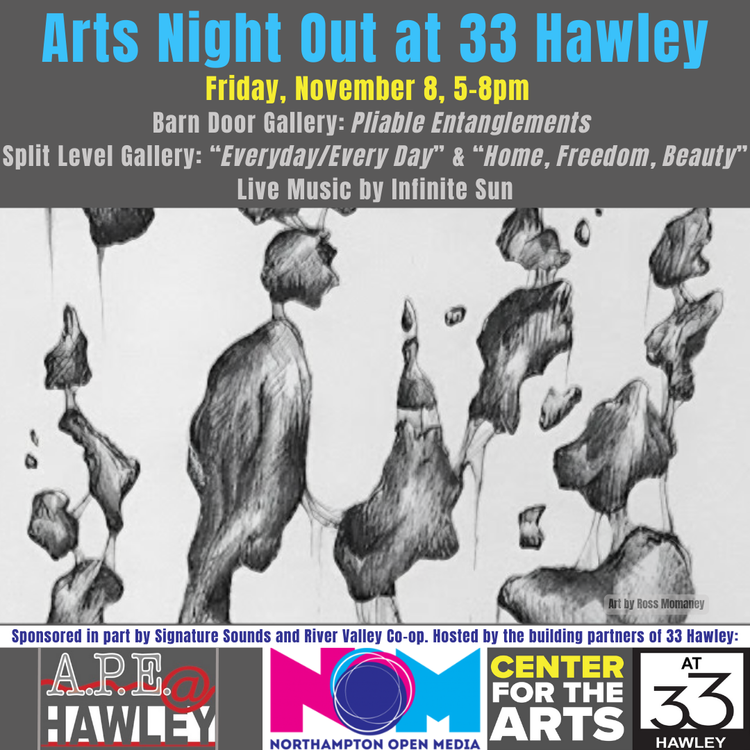
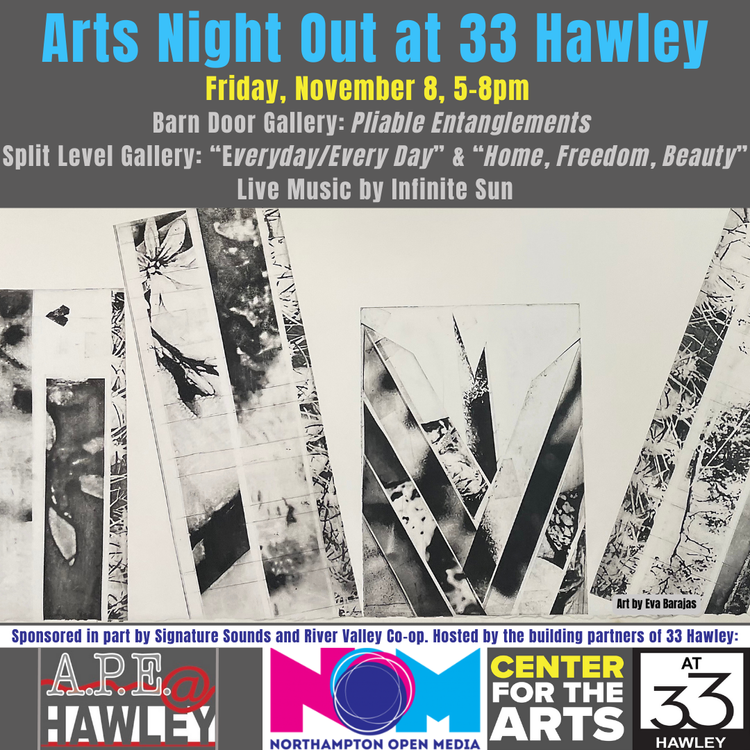


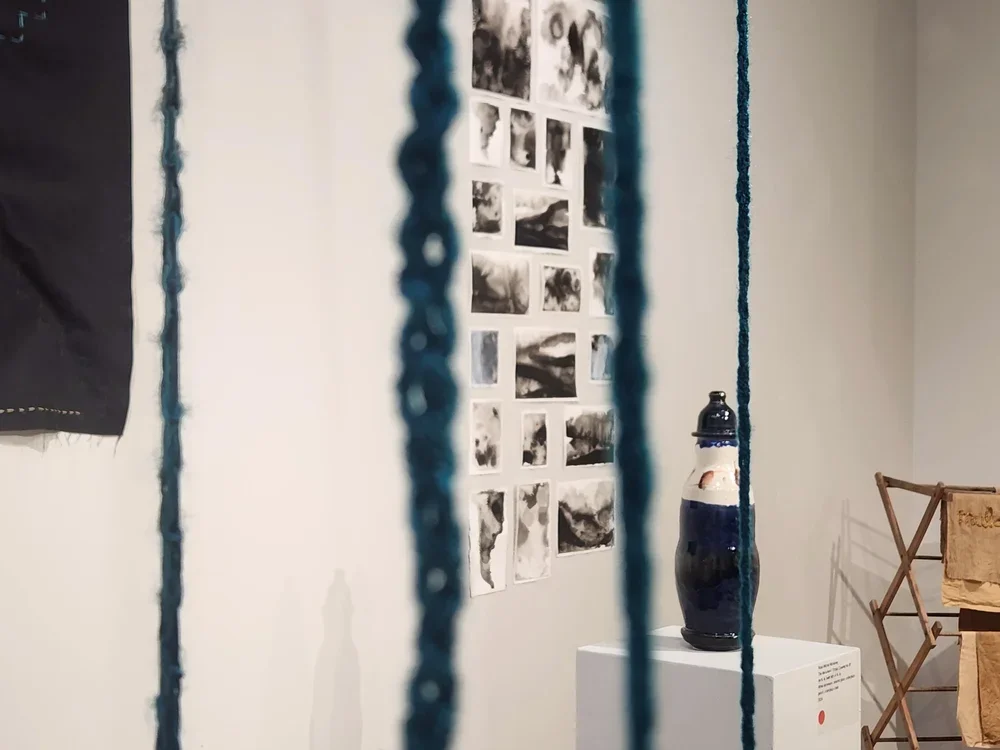
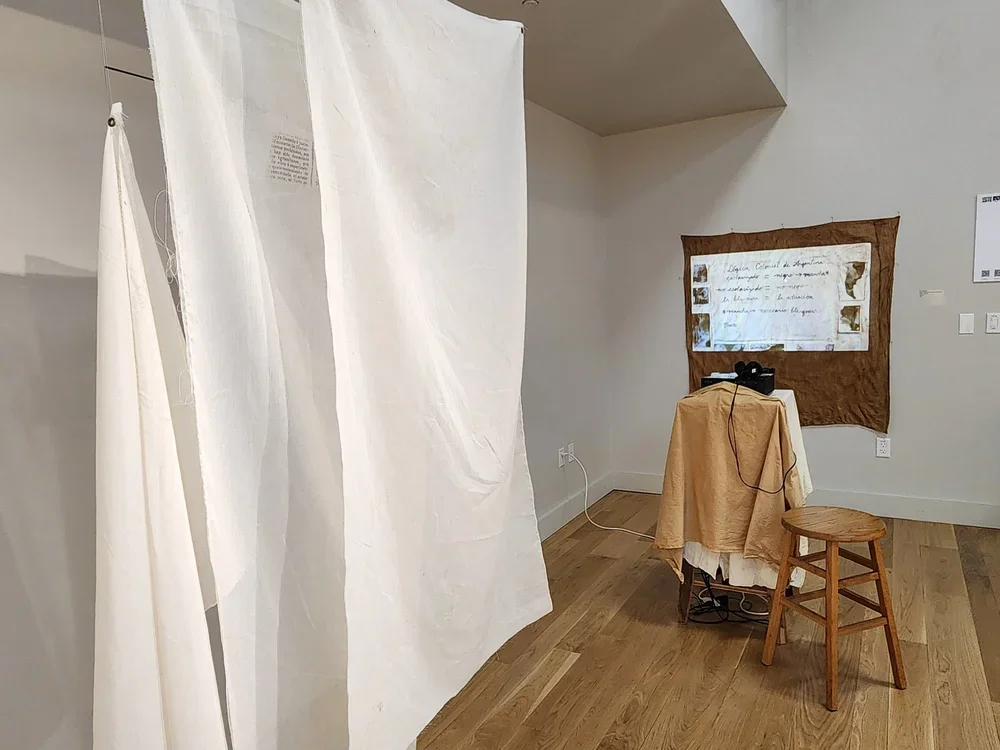
Pliable Entanglements
Eva R. Barajas, María Sparrow, & Ross Momaney
November 5 - November 30
Opening Reception on Arts Night Out
Audio Timestamps:
Pliable Entanglements Statement 00:00
Eva R. Barajas 02:07
María Sparrow 03:10
Ross Momaney 03:55
We ask that you see our body of work as an imperative call to be present in our shared Pliable Entanglements. Our visual collection serves as evidence illustrating the interconnectedness we inhabit through universal and foundational elements. The experiences we imagine, the instances that could have been, and the concrete histories that make up who we are all intertwine here. Pliable Entanglements offers the viewer the ability to honor their own past, present, and future while simultaneously acknowledging the malleable connections we have to the network of lives to which we are linked. These pieces serve as reflections of the overlapping histories and experiences of the artists, reminding us that we are not the first, the only, or the last to have them.
Through drawing and printmaking, we seek to explore the narratives of the past and their infinite connections to the present. Our shared tactile connection to the earth manifests through ceramic vessels that act as relics of timelines, memories, and experiences in alternative and imagined landscapes. Using clay to construct artifacts of invented experiences reflects the conception of the personal histories of what could have been and serves to fill in the gaps of the unknown. The ever-present threads that connect all of us are expressed through fibers weaving together the communal and personal histories we have experienced, both real and internally constructed. Together, these pieces bind the many histories and experiences of the artists while offering a moment in time to build a shared experience with viewers.
As humans, we are all connected through shared Pliable Entanglements. Our personal landscapes are infinitely malleable and subject to ever-evolving internal and external influences. May this presentation of artwork guide you to value the permeable and unseen links that connect us all and carry the notion that anything we observe, we change; anything observed changes and connects us in perpetuity.
-
Eva R. Barajas (she/her/ella) is a disabled, queer, interdisciplinary artist, educator and cultural producer.
Descended from Southern Paiute/ Comanche and mestizaje peoples. Currently living and working on the unceded land of the Nonotuck people (Northampton, MA ) pursuing a Master’s in Art Education at the University of Massachusetts, Amherst, with a focus on accessibility education in the arts.
Her installations reflect her dedication to exploring disability, craft, grief, stimming, care, collectivity, and joy. An invitation to engage with the intricacies of creative labor, embracing the malleability of experiences and the potency of imagined scenarios.
Her goal is to craft spaces that resonate with the vibrancy of unspoken dialogues, the malleability of experiences and a celebration of infinite diversity in infinite combination.
-
María Sparrow (she/they) is a teaching artist based in Franklin County, Massachusetts. Sparrow employs painting, fiber, and printmaking techniques in combination with historical research in order to probe questions of memory, identity, alienation and belonging. With half of their family based in Argentina and half in the U.S., Sparrow’s ongoing “Stains” series seeks to understand racial formation across these cultures. Focusing here on research on racial formation in Argentina, the artist offers a specific case by which Argentine and non-Argentine viewers alike might consider their own cultural racial constructs.
-
Ross Momaney (he/him) is a visual artist and arts educator. He grew up playing in the woods of West Dummerston, Vermont with plenty of room to roam and explore, letting his vivid imagination run free. As a child, he often played with and built elaborate imagined worlds with lincoln logs, LEGOs, and any other materials he could find.
From a young age, Ross knew he wanted to be a teacher. He attended the University of Maine at Farmington where he earned a BS in Elementary Education and Art. He is currently in the Master’s program for Art Education at The University of Massachusetts at Amherst. Prior to his graduate work, Ross was a teacher at an elementary school on Deer Isle, in Maine. There he taught writing and English, as well as third grade before becoming the school’s art teacher. His work in the classroom supports imaginative inquiry and play while providing equitable experiences in the arts for all learners.
Ross’ own artwork focuses on process and self-interpretation with an emphasis on constructing imagined worlds and relics from his imagination. At the core of his artistic practice, Ross centers on creating pieces that illustrate how he perceives and experiences the world. His work delves into the ways lines exist in our environment, both natural and constructed, and investigates how these elements can shape our understanding and awareness of the different landscapes that surround us. Most of Ross’ work utilizes clay to create and build relics of personal expression. Ross examines how signs, text, and images function as tools for navigation and communication, as well as how a given object serves as an artifact of personal experience. Ross’ art invites viewers to reflect on the subtle yet powerful ways that visual language influences our perception of the world.
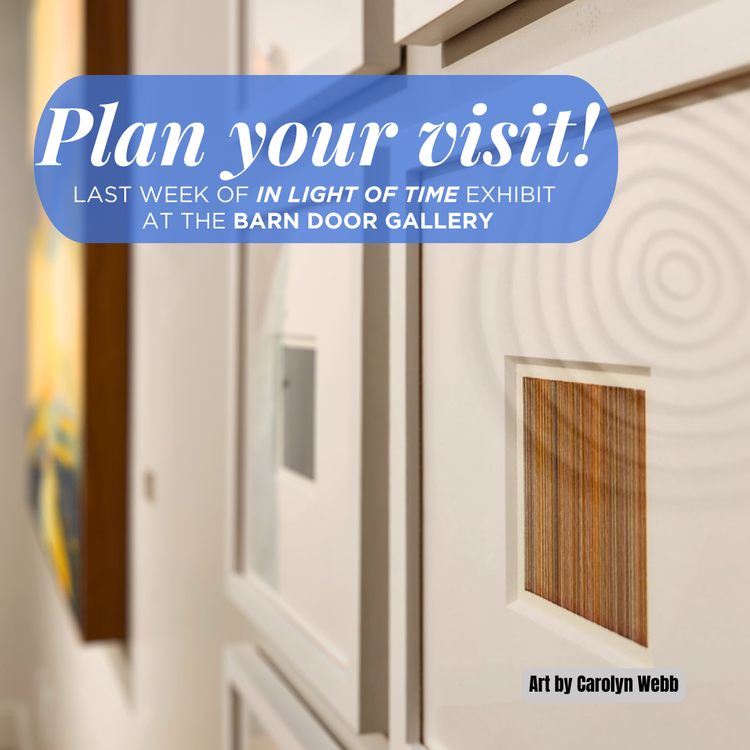
October 2024
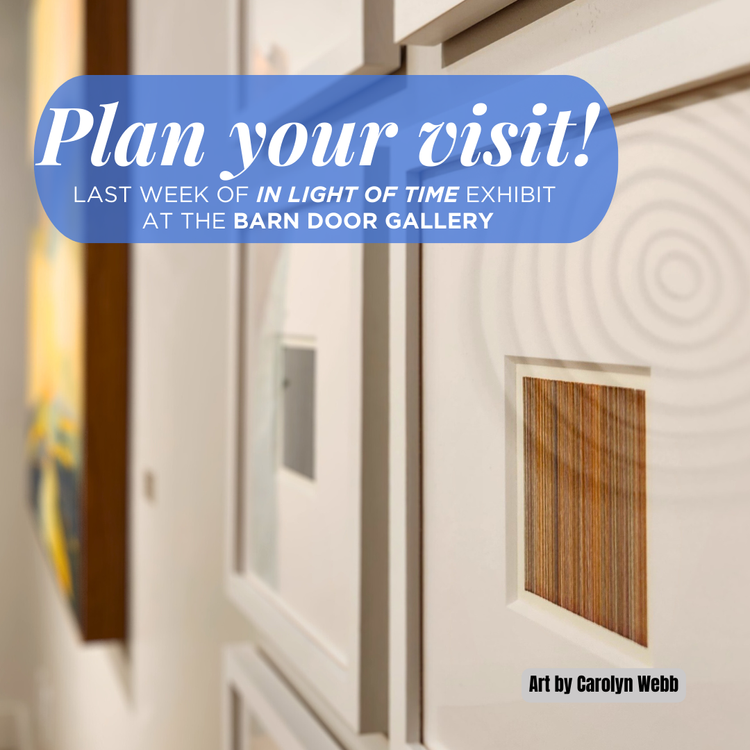
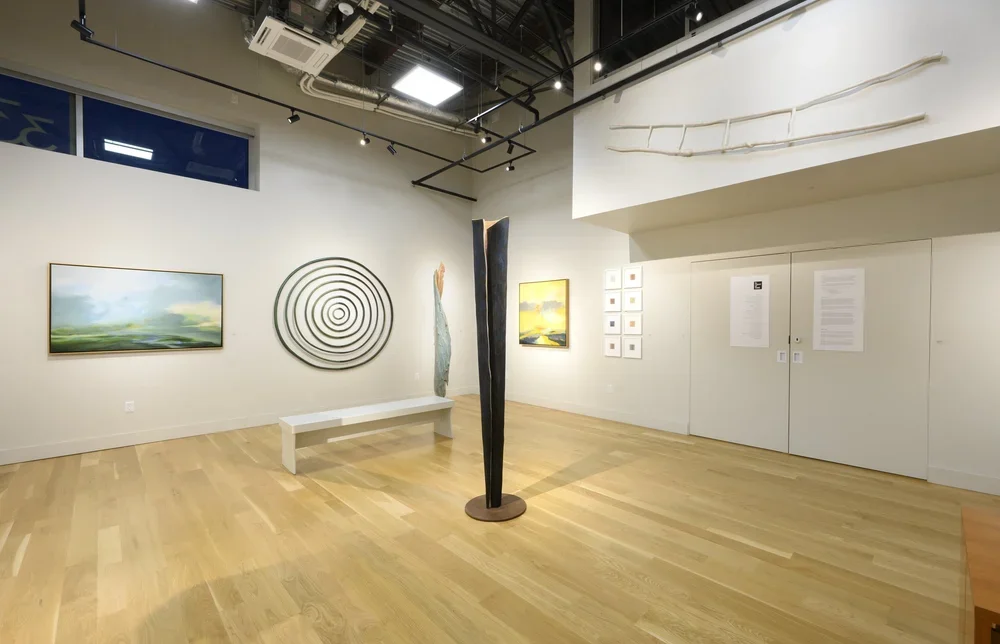
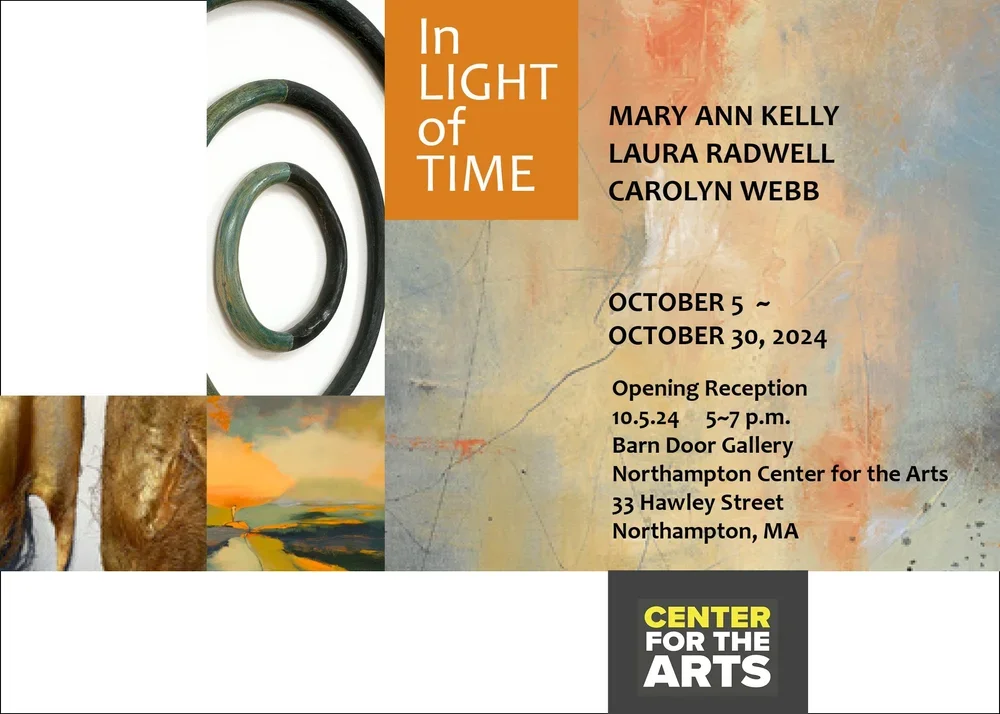

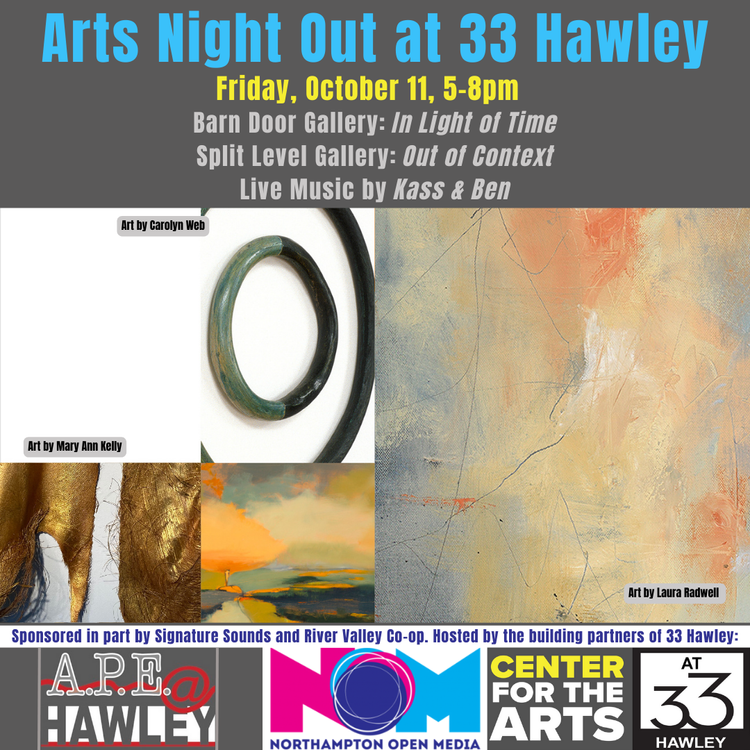

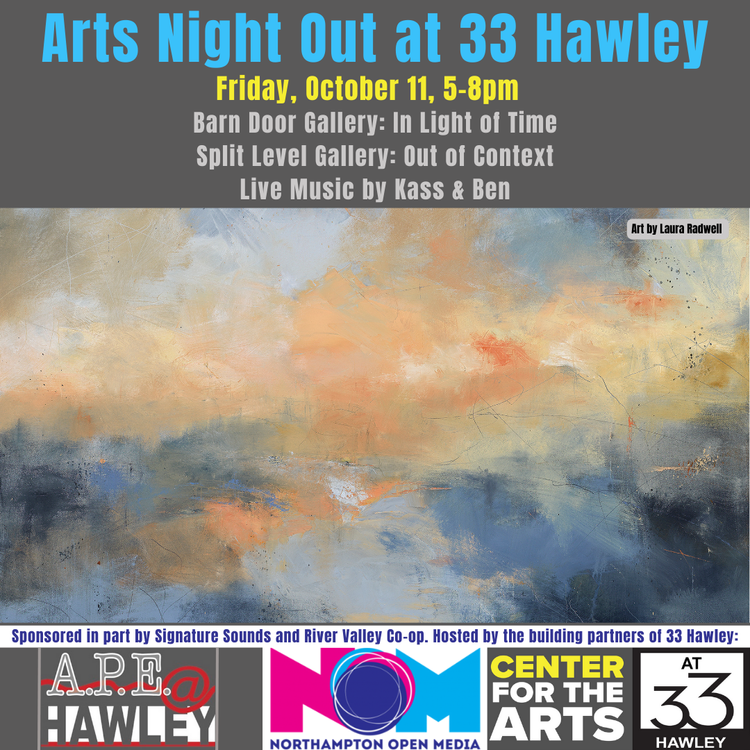
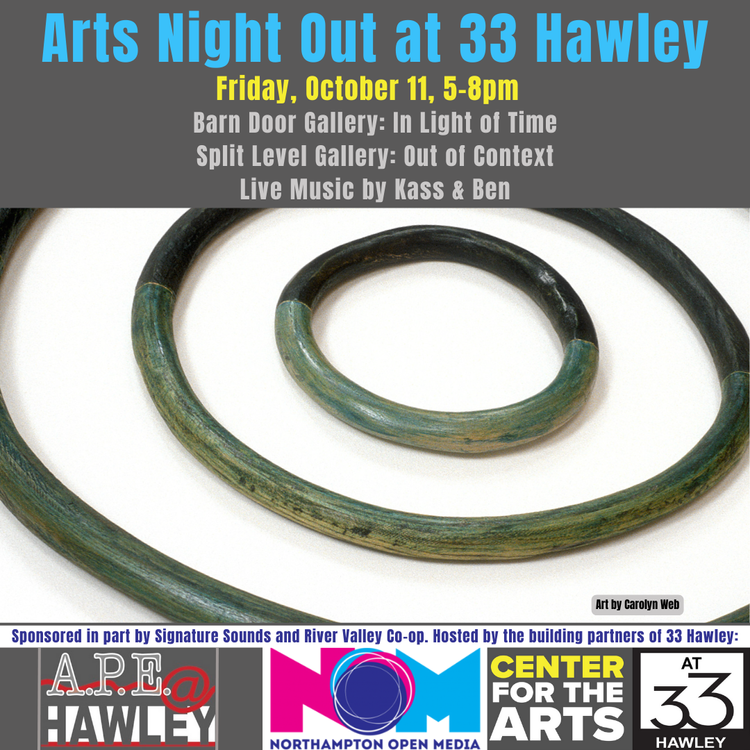
In Light of Time
Mary Ann Kelly, Laura Radwell, & Carolyn Webb,
October 5 - October 30
Opening Reception on October 5th
We three artists: Mary Ann Kelly, Laura Radwell, and Carolyn Webb, are celebrating our longstanding relationship to the Connecticut River Valley. Individually, we realize how we have been altered, inspired and influenced by our immersion in this special place over time, recognizing and responding to its unique natural beauty. Over time and in its light, we find individual and profound spiritual allure: the lay of the land, the verdant woods, the plentiful waters. Perhaps this exhibition can also be seen as a gesture of gratitude for a community which seeks to protect its natural resources, promoting preservation, public interaction and access to the shared bounty.
Through painting, sculpture, prints, and drawings, we share our journeys of discovery, for the first time together. This immersive installation, featuring a blend of lines, gestures, color, and symbolic forms, is a creative conversation with each other. The distinctive style of each artist complements the others, flowing between the walls and floorspace to celebrate timelessness, resilience, harmony and grace.
-
Mary Ann Kelly made a quality of life move with her family to Northampton in 1997 from Washington, DC. Here the rich, natural reminders of transformation, metamorphosis and the aging process inspired her to celebrate these themes in her two- and three-dimensional abstractions. These artworks enable her to pursue her love of light, gestural line, texture, and colorful patinas while manipulating non-traditional and natural materials. Each work is a mindful journey in space-making — celebrating the simplicity of form, quiet space, and the wisdom of stillness — evoking contemplative presence and timelessness.
Mary Ann received her MFA from Massachusetts College of Art in 1987. Since then she has studied with various teachers and was accepted to a residency at Vermont Studio Center in 2002. She has exhibited her work throughout Massachusetts, in Vermont, New Hampshire, Connecticut, and New York City.
“My love of Japanese aesthetic and calligraphy informs my work, including the concept of Ma.” Ma is the pure, essential void between all things.
- an emptiness, yet full of possibilities
- a resting space, or a pause between notes
- silent intervals that give form
- and therefore an invitation to breathe”
-
In the early 1990s, while focusing on growing a small communications business, Radwell began capturing detailed images of surfaces that chronicled erosion and decay, and began a process of manually collaging images of real world objects that she transformed into abstract compositions. This work continued over time, enabling her to harness evolving technologies and to make use of digital art forms incorporating both her images and drawings. In 2014, after a long hiatus, she returned to oil painting, but in ways that were informed by the digital work of previous years. Now Radwell paints “from the inside out” and produces lyrical abstract studies using color, texture, and form that retain landscape’s resonances.
Radwell has exhibited locally and regionally. In 2020, she won First Prize in the New Britain Museum of American Art Annual Nor’Easter Juried Exhibition. Several of her paintings have earned places in juried exhibitions in New York, Connecticut and Massachusetts. She spent six weeks (two artist residencies) at the Château d'Orquevaux in France.
“How does a visual narrative begin?
Perhaps, in my case, deferring my dream to paint brought a multi-layered storage process of audio/visual observations of natural beauty and the manmade cacophony in the outside world, depositing subconscious recordings of the soft and sweet, sometimes loud and discordant sounds. These contributed to the inventory of impressions collected in my inside world.
The ultimate result of this process could be described in emotional terms, yet it seems simplistic to describe a creative practice as a reflection solely of emotions; but it is. The world is in chaos, and painting from such a personal place is unavoidable. If the outward expression of the good, the bad, the ugly, the sublime are all mixed together, then what more is there? Having lived with ADHD most of my adult life, I have learned to discipline thoughts and actions in my work life for almost half a century. Now it’s a different time, and the challenge is not to accomplish discrete tasks but rather to let myself be without such careful filtering. In some sense it is an unholy mess, which might explain why the work I’ve done over this past decade varies so much and travels along a spectrum of disharmony and imperfection to serenity and peace. It’s later in my life, and there is much to express; I choose to do it without the pressure of rules. The things I strive to incorporate into my work is a bit of mystery, unpredictability, color, always glorious color, and a touch of light.“
-
Sculptor and printmaker Carolyn Webb has maintained her studio in Williamsburg since receiving her MFA in sculpture at UMASS in 1981. Previously she studied at the Pennsylvania Academy of Fine Arts where she was awarded a Scheidt Traveling Scholarship and a post-graduate fellowship in sculpture.
Other awards include a Massachusetts Cultural Council Grant for Sculpture, an A.R.T. Grant, a Fellowship Residency at the Scuola Internazionale di Grafica, Venice. Her work can be found in the permanent collections of the Pennsylvania Academy, the Hyde Collection, the New York Public Library and the University Museum of Contemporary Art at UMASS among others.
Growth, renewal, and a fascination with processes that build and destroy form are the basis of her life’s work.
“My original perception of the world through observation of incremental change is expressed in my work, which is often either built over long periods of time with layers of ink in the case of prints or slow carving or laminating techniques in built wooden pieces. I regard the practices of sculpture and printmaking as intertwined and complementary, as both are material and process driven. I work in many different media. Each is employed for their distinct tonal resonance in service of the work I envision.”
Listen to their interview on WHMP Radio with host Lary Hotts HERE