
THE BARN DOOR GALLERY
AT 33 HAWLEY
Stewarded by the Northampton Center for the Arts (NCFA), the Barn Door Gallery supports our mission to foster community connections through the arts, and is a dedicated venue for evolving, transformative dialogue between artists and audiences.
OPEN HOURS:
12 pm - 7 pm - Wednesday, Thursday, Friday & Saturday
Closed - Sunday, Monday & Tuesday
The Barn Door Gallery is ADA compliant and admission is free.
Additional information can be found on our FAQ document.
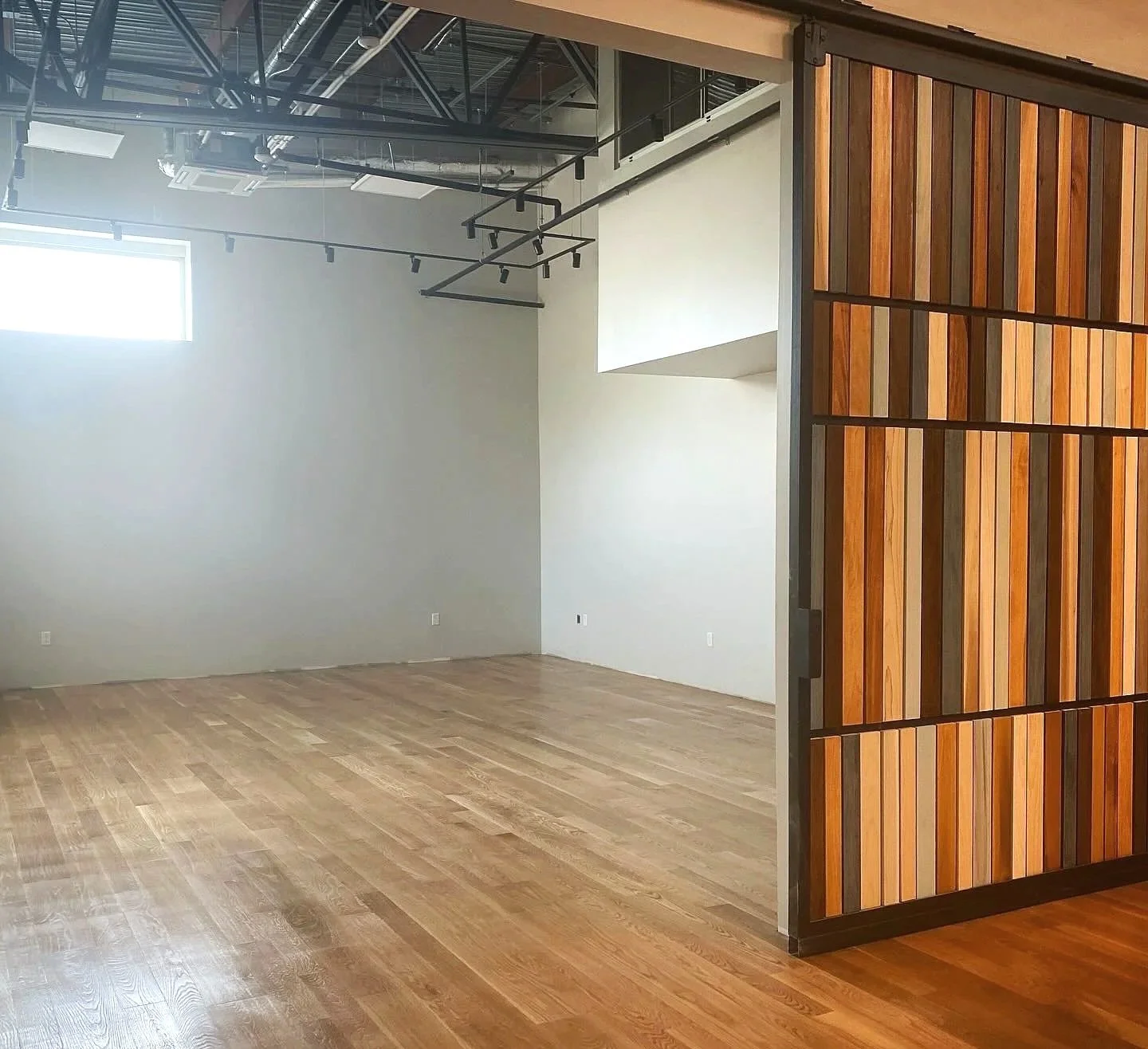
THE SPLIT LEVEL GALLERY AT 33 HAWLEY
Stewarded by the Northampton Center for the Arts (NCFA) and A.P.E . (Available Potential Enterprises, Ltd.) the curation of this gallery is shared by both building partner organizations and supports our mission to foster collaboration and community connections through the arts.


CURRENT EXHIBITS:

OCTOBER BARN DOOR GALLERY 2026
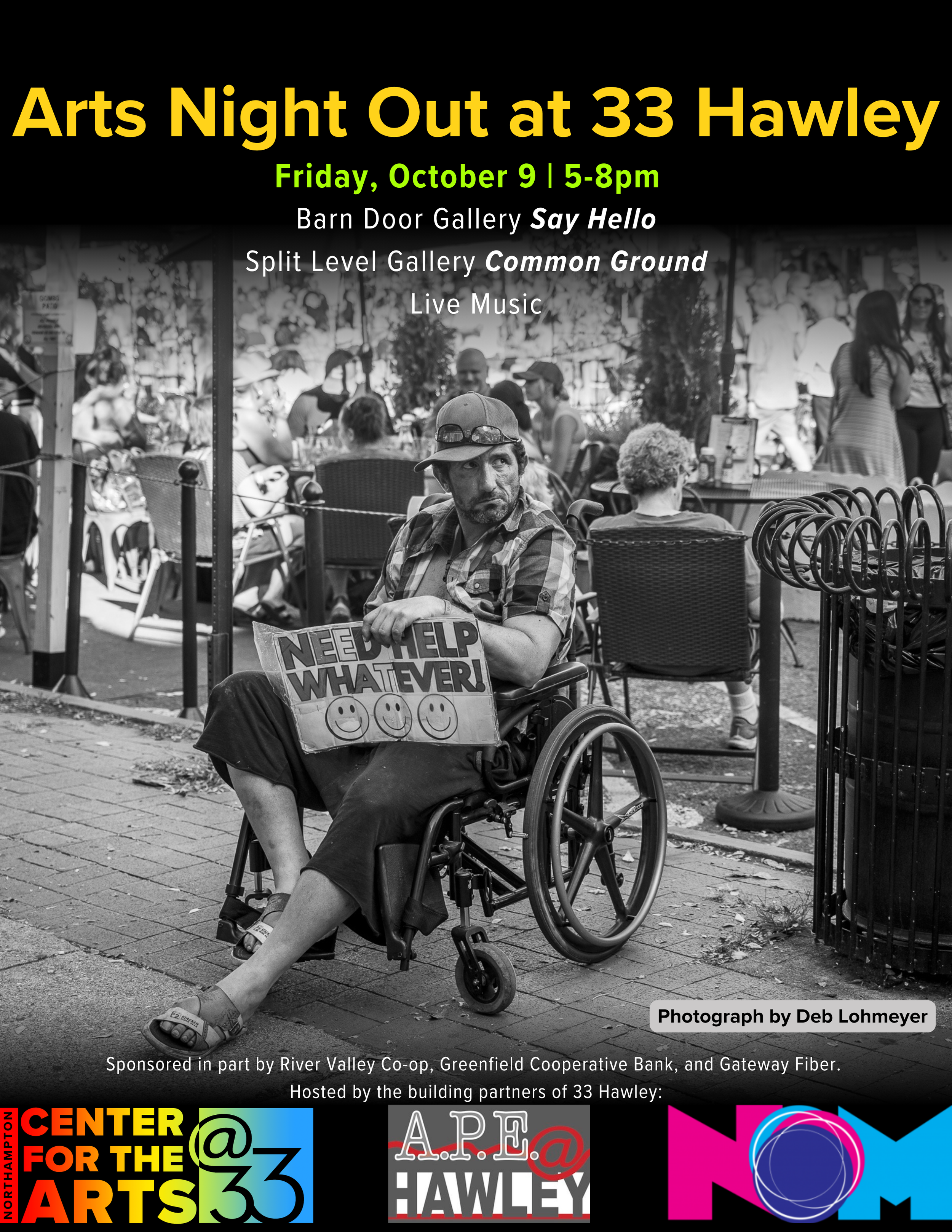
Say Hello
Deb Lohmeyer
October 2 - October 30
Opening Reception on Arts Night Out
Say Hello is a photo and text exhibit of large black and white portraits of people that I
have met on the streets of Northampton. Some share their stories, but usually we just
have neighborly conversations. I always ask for permission to take a photo and if it’s
okay to use it on social media or in exhibits. After I print the photo, I try to find each
person to give them a copy. Over time, we develop a relationship which sometimes
leads to a deeper understanding of their lives. My goal is to break down stereotypes of
our neighbors, many of whom are houseless, and to encourage others to acknowledge
their presence by at least saying “hello.”
-
Deb Lohmeyer (she/her), a self-taught photographer, has lived in the Pioneer Valley for 40 years. She began taking photos in 1979 with a Pentax K1000 in Southwest Missouri and renewed her passion using a new digital camera and taking classes at Hill Institute in Florence, MA, and The Fine Arts Work Center in Provincetown, MA. Since 2024 she has focused on taking black and white portraits of people she meets on the streets of Northampton. In 2026, she published This World, a book of her photos along with poems by Gail Thomas. Proceeds from the sale of this book have been donated to the Center for New Americans, Manna Community Kitchen, and the Survival Center in Northampton.
IG@deb.lohmeyer

OCTOBER SPLIT LEVEL GALLERY 2026
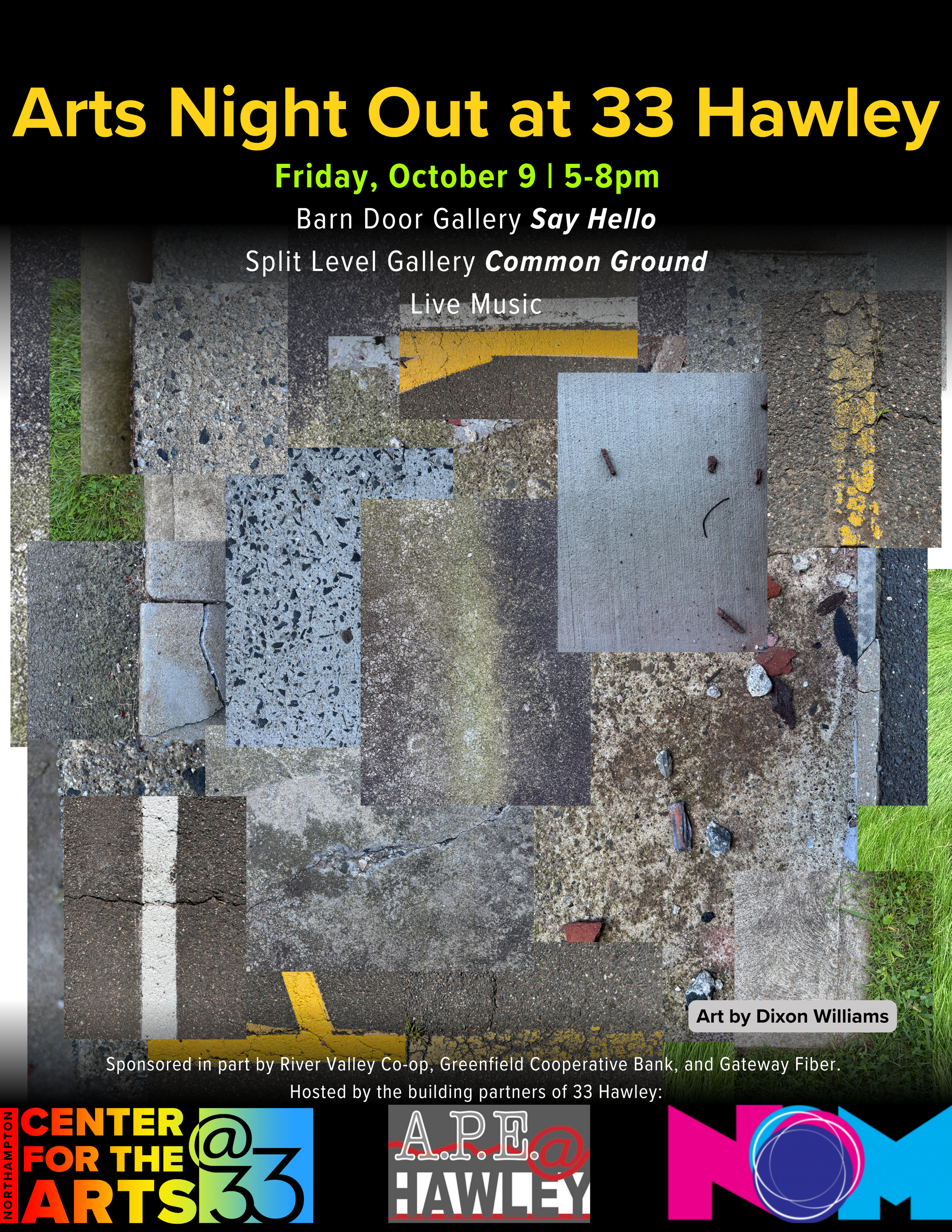
Common Ground
MHC Art Studio Department Seniors' Show Curated by Lisa Iglesias
October - October
Opening Reception on Arts Night Out
Common Ground brings together the work of senior artists from Mount Holyoke College, whose varied practices reflect a shared period of exploration, experimentation, and discovery. Working across diverse media, perspectives, and approaches, these artists arrive at the exhibition from different places and find themselves, for a moment, in the same place. The artists' works emerge from a shared community and environment while revealing distinctly individual ways of seeing, questioning, making, and responding to the world. Across the exhibition, points of connection emerge through the possibilities of conversation: between materials and ideas, personal experience and collective experience, the familiar and the unexpected. Presented in the fall, a season of transformation in the landscape of New England, the exhibition marks a significant moment of transition for these artists. As they approach the threshold between undergraduate study and what comes next, Common Ground offers an opportunity to pause, gather, and consider where they have been and where their practices might lead them.
Exhibiting Seniors:
-
Elise (she/her) is a French-American artist and designer born in New York City. She is currently pursuing a BA in Studio Art with a minor in Environmental Sciences at Mount Holyoke College. Elise’s practice focuses on the intersection between the natural world and human experience. Drawing inspiration from organic systems and psychological processes, Elise creates whimsical narratives that explore how environmental impacts and changing identities collapse together to reconcile a world rooted in connection, empathy, and reciprocity. Her art spans across multiple mediums including illustration, sculpture, design, painting and printmaking. In this set of works, Elise investigates the intimate relationship between nature and nurture: the continuous, spontaneous interactions between genetic inheritance and lived experience that converge to shape the self.
-
Kendall (she/they) is a Filipino-American textile artist born and raised in Los Angeles, California. She is currently studying art studio and architecture at Mount Holyoke College in South Hadley, Massachusetts. Kendall's work focuses on the exploration of her Filipino identity and culture, personal/familial archival research, mental health and wellbeing, memory, and personal experiences. Their work spans across a multitude of art forms, such as quilting, crochet and knit, wire sculpture, cyanotype prints, poetry, and photo books/book binding, to create a visual narrative of the themes of her work. Kendall Cuenca aims to be known first and foremost as a storyteller, using her artwork as a visual language to pass down stories and create physical heirlooms for future generations.
-
Amira (she/they) is a third-culture mixed-media artist pursuing an undergraduate degree at Mount Holyoke College. The mediums that Amira explores include video art and installation, cyanotype, screenprinting, and zine-making. They are an ethnically Somali artist born in Saudi Arabia and raised in Syria. Her conglomerate identities inform her worldview, which brings up themes such as grief, nostalgia, belonging, and gender.
IG@downalameda
-
Sarah is a visual artist based in Hudson County, NJ, and pursuing a degree in Psychology and Art Studio at Mount Holyoke College. Both their upbringing and education has instilled values of community, loyalty, and profound love in them that is consistently imbued into their practice. They work primarily in painting, illustration, and mixed media; they have been creating for as long as they remember, and their art has always served to tease out layers of their own human experience. Heavily informed by their study of psychology and desire to pursue Mental Health Counseling, Sarah is deeply inspired by the psychological processes that govern how we perceive ourselves and others, as well as those that govern societal interactions. Sarah often seeks to explore identity and relationships between the self and the greater systems surrounding oneself in their work.
-
angie fernandez (she/they) is a Dominican-American multimedia artist from the Greater Boston area of Massachusetts. They are currently pursuing their Bachelor of Arts in Psychology and Studio Art at Mount Holyoke College. fernandez uses the arts as a tool in the act of reflection, as memories fade the more they are recalled she hopes to capture them in their purest forms. Her works range in materials as they aim to showcase the chaos and rapid developments that occurred throughout their childhood. The highlight of their works are the stories her titles tell, with spanish titles fernandez feels they can most directly speak to that child inside them and honor not only her but the family who have grown with her memories.
-
Cosima Eyre is an emerging artist studying studio art at Mount Holyoke College in South Hadley, Massachusetts. Her primary focus is in contemporary oil portraiture and 2-D multimedia paintings which utilize silkscreen printing and photocollage processes. Her figurative works are intentionally undefined to investigate the historical significance of social status in portraiture. Through time, oil has gained an association with status as the predominant medium for portraiture of nobility, government officials, and religious figures. In Cosima’s paintings, deemphasis on facial definition allows gesture, texture, and narrative to take precedence over social rank. This approach expresses the process of identity exploration of the subject, opposed to merely communicating power.
-
Sammie (she/her) is an artist from the Memphis area in Tennessee. Currently, Sammie is studying at Mount Holyoke College and is double majoring in Art Studio and Anthropology. Working in many mediums, her favorites are acrylic paint, oil pastel, and charcoal. Sammie gets inspiration from her own lived experiences and works to explore what it means to be human. In asking these big questions, Sammie finds that community is an essential part of being human. So to find solutions to her questions, she works to affect and be affected. To unravel connection with others through her art she strives to picture moments that contain some of the visceral forces that shape her experience before conscious thought; connection through emotion and feelings rather than words.
-
Zoey (she/they) is a multimedia artist from Spokane, Washington. She currently attends Mount Holyoke College in South Hadley, Massachusetts and studies Art Studio and Architectural Studies. Their art often focuses on inspiring joy through colorful, playful scenes of humor and vibrant highlights of human connection. After a summer of painting, Zoey has a newfound passion for oil painting as well as acrylic experimentation. She also enjoys carving relief prints to create high contrast scenes that highlight the bright tones of nostalgia and memory. Through her new fascination with animation, she aims to present imagery of joy through human interaction and the pleasure of inhabiting a human body using the art of stop motion. The series featured in this gallery are inspired by Zoey’s captivation with the innate creativity of children, fueled by her passion for the importance of play.
-
Isanna (they/them) is a New England based artist currently studying at Mount Holyoke College. Creating art has been a lifelong passion of Isanna’s. Outside of their art career, Isanna enjoys birdwatching, urban exploration, and hanging out with their friends. They enjoy creating in various disciplines but primarily focus on illustrative work and printmaking. They often explore themes relating to mental health and social issues in their work. This triptych combines both of those themes, highlighting how advertising often exacerbates existing body image issues. Isanna took inspiration from 1920’s perfume advertisements. They enjoyed the detailed illustrations and dramatic expressions of the ads. They chose to have a simple color palette, with the pieces slowly losing color, going from vibrant blue and silver to a simple greyscale. They did this both to highlight the illustrations and to add to the story their work aims to tell. As a whole, this triptych tells the story of the desperation many have to fit in, often looking towards advertisements as their guiding star.
-
Alyssa (she/her) is a New England-based artist currently pursuing her undergraduate degree in Studio Art at Mount Holyoke College. Their work is focused on experimentation with different materials and techniques to create a practice where almost every piece is new and unique in its own way, often swapping between various mediums from project to project. Some of such mediums include acrylic painting, watercolor painting, pencil illustration, digital illustration, digital video, and sculpture. She borrows heavily from her lived experience as a neurodivergent queer artist, but also likes to indulge in works revolving around fictitious worlds and ideas to embrace their imaginative side.
-
Annika (she/her) is an artist based in the Los Angeles area. She enjoys exploring different mediums and materials. Previously having made art primarily focused in mixed media video installations, ceramic and clay forms, fiber arts, embroidery, and sculpture. Her practice explores themes of memory, identity, and the passage of time. She favors bright, vibrant colors, compelling textures, and the contrasts that come from mixing realism with exaggerated visual illustration. Annika is currently in her final year of pursuing a BA in Art Studio at Mount Holyoke College.
-
Yilan (she/they) is an artist from Beijing, China, working in photography, moving image and installation. She is currently pursuing a double major in Film, Media and Theatre and Art Studio at Mount Holyoke College, and is based in Brooklyn, New York. She photographs and records continuously and without a plan, gathering ordinary and transitional time. The editing comes much later, sometimes years after the footage was shot, once distance has altered what she remembers seeing. Her installations return that material through loops, layered sound, and arrangements that repeat, overlap, and refuse to resolve.
IG@songlanys
-
Estella (she/her), also known as Khuê, is a Vietnamese artist based between Ho Chi Minh City, Vietnam, and Massachusetts, United States. She is currently pursuing a B.A. in Studio Art at Mount Holyoke College, alongside a certificate in Arts Management from the University of Massachusetts Amherst. She is interested in time-based art and creating immersive and interactive environments through moving images, sound, and installation. Her practice experiments with video art, installation, and site-specific work, exploring experiences of in-betweenness, displacement, belonging, and identity through the relationships between the body, language, and cultural context. The work featured in this exhibition is Estella’s experiment with translating a time-based practice into a two-dimensional format.
-
Margot (she/her) is an artist and future art educator based in Southern Vermont and Western Massachusetts. She is currently pursuing a BA at Mount Holyoke College, majoring in Art Studio and minoring in Education. Margot works with many artistic mediums, including painting, printmaking, collage, and mixed media. The works from this botanical series were an exploration into eliminating the pressure of perfectionism and the need for precise representation. Loose sketches were done from life in the Mount Holyoke College Talcott Greenhouse. The final paintings were then referenced off of those drawings, creating an interesting balance between painting from reference and from memory.
IG@artbymargotp
-
Felicity (she/her) is a Western Massachusetts based artist studying at Mount Holyoke College. She works in mediums ranging from printmaking, fiber arts, oil painting and collage, exploring themes of nature, family and nostalgia. This work consists of six monotype prints that represent each of the six semesters she has spent at Mount Holyoke College, documenting how the plant changed from life to death over time. As the viewer moves from left to right, each print becomes progressively less detailed and vibrant, emphasizing deterioration and the quiet erosion that comes with passing time.