
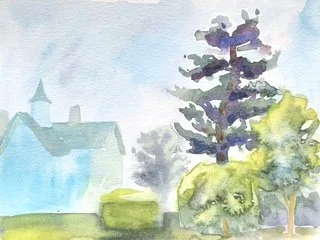
WATERCOLOR GARDENS
TAUGHT BY PAIGE QUINN-VASIC
FIVE TUESDAYS, JUNE 2-30, 6:00-8:00 PM
COST: $200-275, SLIDING SCALE
REGISTRATION: EMAIL PAIGESQUINN@GMAIL.COM
In this watercolor class, we will explore the components that build a captivating garden landscape. It's a beautiful time of year with ephemeral blooms cropping up all around. We've already said goodbye to nearly all of the cherry blossoms, but the lilacs still have a good week left. Capture the beauty of your garden or surrounding area by painting a timeless landscape and make the feeling last. We will learn techniques that are the foundation of painting in watercolor such as basic color theory, washes, wet into wet, masking off sections, and more.
The format of the class is loose, but guided in technique at the start of each class. The subject of your work and how you create it is ultimately your choice. Each class will begin with a brief demo and then it is up to you how you will apply what you’ve learned and approach your garden landscape image. Clear step by step processes are also provided for those who appreciate more structure on their journey. Whatever your vision, we will break it down together and find opportunities to add unexpected flair with some playful, thoughtful techniques.
About the instructor: Paige Quinn-Vasic (she/her) is a local professional artist who is well-versed in many mediums such as oil painting, printmaking, ceramics, and sewing. She completed her bachelors in fine arts and art education at The School of the Art Institute of Chicago, which drove her to explore an interdisciplinary practice. Her medium of choice in the last few years has been collage with painted paper, but recently got back into oil painting. Her practice tends to hop between mediums as she follows the whims of her creative inner child, exploring whimsy, peculiar curiosities, and confronting microaggressions. Since moving to Northampton in 2023, she has earned a LCC grant for her community project, Noho Art Club, around which she curated a group show in November 2025. Her focus lately has been teaching and planning creative classes and events, one recently being held at The Smith College Museum of Art. She has been exhibited in Jackson Junge Gallery in Chicago, Sip 413 in Florence, and The Northampton Center for the Arts. You can see more of her work at www.paigesquinn.carrd.co or instagram.com/paigesquinn and instagram.com/nohoartclub on Instagram.
WATERCOLOR SUPPLY LIST
The instructor will have some paint tubes to share small amounts of paint and paper you can buy by the sheet as you go, but do not rely on them to provide full palettes ready for students.
PAPER:
1 full sheet (22 x 30) hot press watercolor paper $10/sheet in class recommended
1 full sheet (22 x 30) rough watercolor paper $10/sheet in class recommended
Brands: Arches, Fabriano, Waterford, Whatman, Strathmore (budget)
A small (8 x 10”) spiral watercolor pad for testing
BOARD:
To hold 15 x 22 size paper so should be a few inches larger in both directions.
Masonite is best though corrugated cardboard and foam core will do in a pinch
PAINTS:
Please avoid cheap sets like Reeves, Maries, Sakura etc. They will create poor paintings. Tube paints only and please bring all the tubes to class Stick to quality brands like Winsor Newton Cotman or Professional, Grumbacher Academy, Da Vinci, Holbein, Schminke, and Van Gogh. The catalogue stores/online like Dick Blick and Cheap Joe’s (American Journey) have their own brand which is very good and cheaper. Colors: any white, any black, ultramarine blue, phthalo blue, alizarin crimson, cadmium red (or hue), cadmium yellow (or hue), yellow ochre Additional colors if you want to add more are cadmium orange, dioxazine purple, lemon yellow, and permanent rose. Metallic and neon watercolor palettes are welcome, but they can be unhelpful when learning the basics.
BRUSHES: Good brushes – a combo of synthetic and natural- are essential. Poor brushes lose many hairs and flatten out when used which will frustrate the painter. So stay away from cheap sets. Sizes: Rounds # 4, 8, 12. Also, a Japanese Hake brush at least 1 ½” wide or any “wash brush.”
PALETTE: large rectangular palette around 10 x 14, like a John Pike palette, with wells for paint all around and large mixing area in the middle. Again, the online art companies sell their version of this palette for half the price of the other brands. Please don’t get the small round ones with a small area for mixing in the middle. They won't be suitable.
MISCELLANEOUS:
Small color wheel (available to borrow)
Blue painters tape (like masking tape) from hardware store
Liquid mask (sometimes called frisket) non-permanent
Masking fluid pen/art ruling pen (available to borrow and/or purchase)
Rubber cement pick-up (available to borrow and/or purchase)
White vinyl eraser
#2 pencil
Black fine permanent marker (micron is good)
2 Water containers (deli containers, big yogurt container)
Small portfolio to carry artwork home – not mandatory, but it could be rainy.
Paper towels